Review Baby Audio Grainferno
I’ve been a fan of Baby Audio for quite a long time. Their plugins often bring something genuinely new to the table instead of just repeating concepts that already exist. One of my personal favorites is Transit, which allows for very creative and musical sound manipulation.
Because of that, I was especially curious about Grainferno. Granular synthesis has always been one of the most fascinating areas of sound design, simply because it allows you to transform almost any sound into something completely new.
After spending some time with the plugin, it quickly becomes clear that Grainferno goes beyond traditional granular tools. It combines classic granular sound manipulation with surprisingly musical and tempo-aware processing while keeping the workflow very simple.
Concept
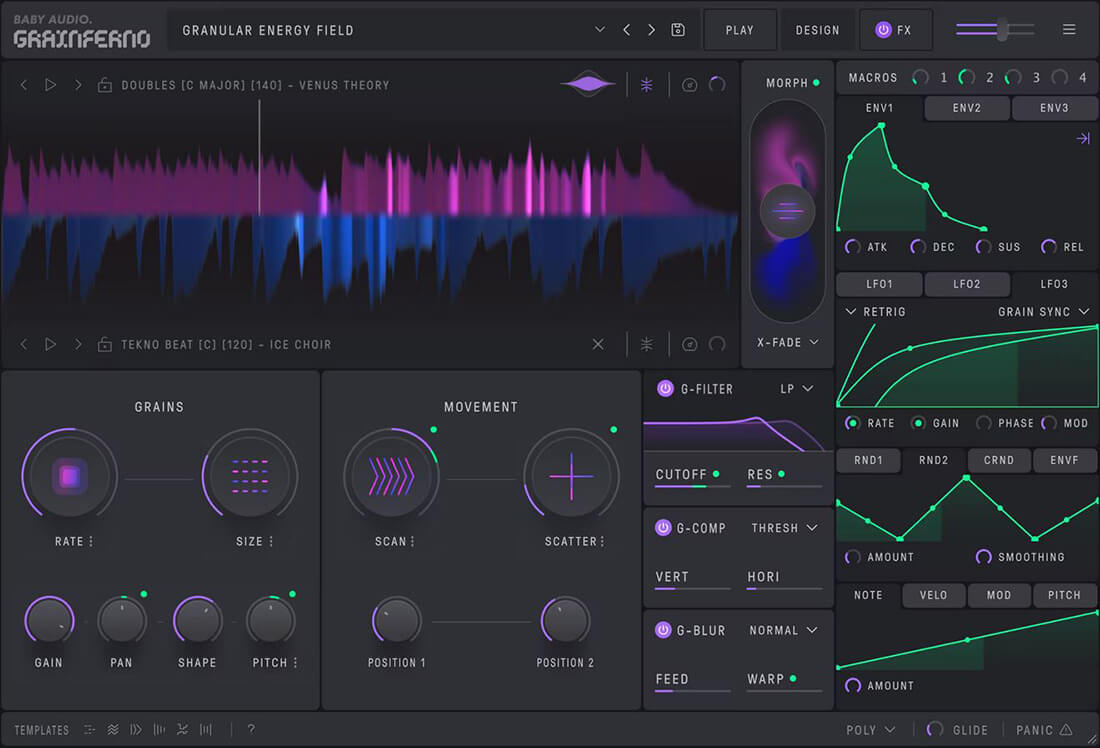
Grainferno is a granular synthesizer instrument built around a new way of generating sounds from existing audio material. Instead of playing samples linearly like a traditional sampler, Grainferno breaks them into tiny fragments called grains. These grains can then be rearranged, stretched, layered or randomized to create completely new sonic textures.
What makes the instrument particularly interesting is that grain playback can reach audio-rate speeds. At these speeds the grains behave more like oscillators, which means that almost any audio file can be turned into a playable synth tone.
Even when used in this way, the spectral fingerprint of the original sample remains present. This creates very unique synth timbres that are difficult to achieve with traditional synthesis methods.
Dual Sample Engine and Morphing
The core of Grainferno is its dual sample granular engine. Two independent samples can be loaded at the same time and blended together using a Morph control. Grainferno offers several morphing modes that determine how the grains from both sources interact with each other.
Depending on the selected mode, the plugin can simply crossfade between samples or switch grains in complex patterns. This makes it possible to create continuously evolving textures that move between the character of both sound sources. Because the source material can be anything from field recordings to synth sounds or drum loops, the resulting palette of textures is extremely broad.
Granular Engine
The granular engine itself offers the typical parameters you would expect from a granular instrument:
-
Grain Rate – controls how frequently grains are triggered
-
Grain Size – defines the length of each grain
-
Scan Position – determines where grains are taken from within the sample
-
Scatter/randomness – adds variation to the playback behavior
An important detail is that several of these parameters can be tempo-synchronized. This allows granular playback to lock perfectly to the project BPM, which opens up interesting rhythmic applications. This is something I personally find super useful. Since many of my sample packs are strongly rhythm-oriented, having granular playback that can follow the project tempo makes Grainferno integrate very naturally into my workflow.
Granular tools often focus mainly on atmospheric textures and unpredictable sound clouds. Having the option to synchronize the output material to BPM is, therefore, a welcome addition and something you don’t often see implemented this clearly in other granular instruments. And that’s a feature that really makes Grainferno special for me.
In fact, while experimenting with Grainferno, I already created some pretty crazy beat loops, and there’s a good chance you’ll hear a few of them in one of my upcoming sample packs. In practice, this means Grainferno can be used not only for atmospheric sound design but also for rhythmic granular textures and tonal synth-like sounds.










Grain Processing
Grainferno also includes per-grain processing tools that shape each grain individually.
These include filtering, compression, and a cool Blur feedback effect that feeds the signal back into the granular engine. Instead of simply processing the output signal, Grainferno routes the audio back into the grain generation stage with subtle pitch modulation. This creates a smeared, evolving character that can range from soft ambient textures to much more unstable digital artifacts.
There is also a “Violent” mode that pushes the effect further by introducing ring modulation into the feedback path, resulting in much more aggressive and chaotic textures. Because these processes happen directly at the grain level, the resulting sounds often feel more organic and complex than traditional effects processing.
Modulation System
Movement is a major part of Grainferno’s sound design potential. The plugin includes a flexible modulation system with: 3 ADSR envelopes, 3 LFOs, 3 random generators, Envelope follower, and MIDI modulation sources.
Almost every parameter in the plugin can be modulated using a drag-and-drop workflow, which keeps the process very intuitive. Modulators can even influence other modulators, allowing for complex evolving modulation structures.
Effects Section
Grainferno also includes a built-in effects section that can be freely reordered in the signal chain. Available effects include: filtering and EQ, compression, distortion and saturation, delay, modulation effects such as chorus or phaser and reverb. These effects are designed more as creative sound-shaping tools than simple finishing processors. Because most parameters can also be modulated, the effects become part of the instrument rather than a static post-processing stage.
Presets and Sound Library
Grainferno ships with a large factory library designed to demonstrate its full sonic range. The plugin includes:
-
325 presets
-
around 378 factory samples
-
six template configurations for different granular workflows
The templates help beginners explore common granular techniques such as cloud textures, rhythmic grain patterns or tonal synthesis. I find these super useful! There is also a simplified Play View, which focuses on sample selection and four macro controls. This makes it easy to experiment with presets and quickly tweak the sound without diving into the full editing interface.
Sound and Practical Use
In practice, Grainferno proves to be a very inspiring tool for sound design. Simple samples can quickly turn into evolving pads, glitch textures, rhythmic patterns or entirely new synth timbres. Depending on the source material, the results can range from smooth ambient clouds to chaotic digital noise.
One thing I particularly like is that the plugin allows musically controlled granular synthesis. Thanks to tempo sync and pitch tracking, many sounds stay harmonically usable in a track instead of drifting into purely experimental territory.
I also appreciate some of the smaller workflow details: The implemented sample lock function allows you to browse presets without changing the loaded sample, which makes experimentation much more practical. It is also possible to listen to the original sample after importing it, making it easier to understand how the granular processing transforms the sound. These may seem like simple features, but some manufacturers still overlook them. What really stands out is how intuitive everything feels. Even without opening a manual it is easy to explore the instrument and achieve useful results, which is far from typical for granular synthesizers.
Strengths
The biggest strength of Grainferno is its balance between creative depth and usability. Granular synthesis often becomes unpredictable and overly complex. Grainferno manages to keep the process approachable while still offering plenty of sound design potential.
The ability to turn almost any audio file into a playable synth tone also makes it a powerful tool for creating unique signature sounds from existing samples. While working with the plugin I repeatedly found myself digging through my sample library, simply dropping random sounds into Grainferno just to see what would happen. With only a few adjustments it’s often possible to transform a sample into something completely different – but still in a surprisingly controlled way. That combination of experimentation and control makes the plugin particularly inspiring to use.
Limitations
While Grainferno is very capable, it is not the deepest granular synthesizer available. The clean and minimal interface is part of that philosophy and makes the plugin far less intimidating than many other granular tools.
Both samples share the same granular parameter set, which limits some advanced layering possibilities. Additional synthesis layers or more filter types could make the instrument even more flexible.
At the same time, many granular instruments on the market go in the opposite direction, offering huge numbers of parameters and routing options. While this can be powerful, it’s also easy to get lost in that level of detail and spend a lot of time experimenting before arriving at something truly usable.
Grainferno takes a different approach. The streamlined design keeps the workflow focused and makes it easy to achieve musical results quickly. For producers who are new to granular synthesis, this approach works particularly well and provides an accessible entry point into this type of sound design.
Verdict & Summary
Baby Audio once again delivers a plugin that focuses on creative exploration and fast results.
Grainferno combines granular synthesis with musical tempo control, flexible modulation and an easy to understand interface. One feature I particularly love is the implementation of tempo synchronization. Being able to work directly inside a granular instrument while everything immediately follows the BPM of the DAW is extremely practical. It allows rhythmic ideas to emerge naturally without having to edit the results afterwards.
There are many granular tools that produce incredibly bizarre sounds, but these rarely work in a musical context, especially when trying to integrate them into a beat. Grainferno takes a much more musical approach. Even when pushing the engine into experimental territory, the results often remain rhythmically usable and easier to place in a track.
What impresses me most is the balance between creative depth and usability. Granular synthesis can often become unpredictable and overly complicated, but Grainferno manages to keep the process approachable while still offering plenty of sound design potential. Even though you cannot dive quite as deep as with some other granular instruments, the balance between creative depth and usability is simply very well executed.
Because of this well thought out design and the inspiring workflow, Grainferno earns the Sounds of Revolution Award.

Visit my BLOG for other vst recommendations, production tips and more!
Cheers,
Oliver Schmitt aka Sounds of Revolution (SOR)