Review D16 Decimort 2
D16 Decimort 2 –Vintage Sampler Character Done Right
I have been a fan of D16’s plugins for many years. Their attention to detail and the way they approach sound design has always stood out to me. When the opportunity came to collaborate with D16 on PunchBox, our bass drum synthesizer, that relationship became even closer. Working alongside their team gave me a much deeper understanding of how their plugins are built and why they behave the way they do.
So when I talk about Decimort 2, I am not just reviewing a plugin from the outside. I have been using it in my own sample pack productions for years, and it has become one of those tools I keep coming back to without really questioning why. It just works.
Now I want to explain exactly why that is.
Sound & Concept
Decimort 2 is built around a specific idea: not destroying the signal, but recreating a very particular kind of sound.
Classic samplers like the early Akai or E-MU units shaped entire genres, especially early hip-hop and electronic music. They added a grit and density that made sounds feel more solid and easier to place in a mix. Today, we are used to extremely clean, high-resolution audio. Sometimes too clean. That slight imperfection is often exactly what’s missing.
Decimort 2 brings that back. Not by randomly degrading the signal, but by modeling the full signal path including conversion, resampling, and quantization. That’s the key difference. This is a controlled recreation of a vintage digital process, and that control is what makes it genuinely useful.
More Than a Bitcrusher
Calling Decimort 2 a bitcrusher is technically accurate, but misleading. Most bitcrushers reduce resolution and sample rate and quickly fall apart when pushed. Decimort behaves differently. It simulates the behavior of a full AD/DA conversion chain and gives you access to parameters that are normally hidden deep in the hardware.
Because of that, it feels less like applying an effect and more like reshaping how the signal behaves at its core.





Range: From Subtle Color to Full Destruction
One of the strongest aspects of Decimort 2 is its range. At one end, it adds just a touch of density and focus. At the other, it pushes the signal into fragments. What makes it stand out is that both ends remain usable.
Even aggressive settings stay controlled instead of dissolving into random artifacts. This makes Decimort not only a color tool, but a serious option for creative distortion and sound design, particularly in genres like hip-hop, lo-fi, and techno, where that kind of grit is part of the aesthetic.
Quantization & Dynamics
The quantization stage already shows how different this plugin is. Decimort 2 offers two algorithms, Mid-Riser and Mid-Tread, which directly affect how the signal responds dynamically. Depending on the mode, transients become softer and more compressed, or they stay tighter and more defined. On drums, this has a clear impact on punch and placement in the mix.
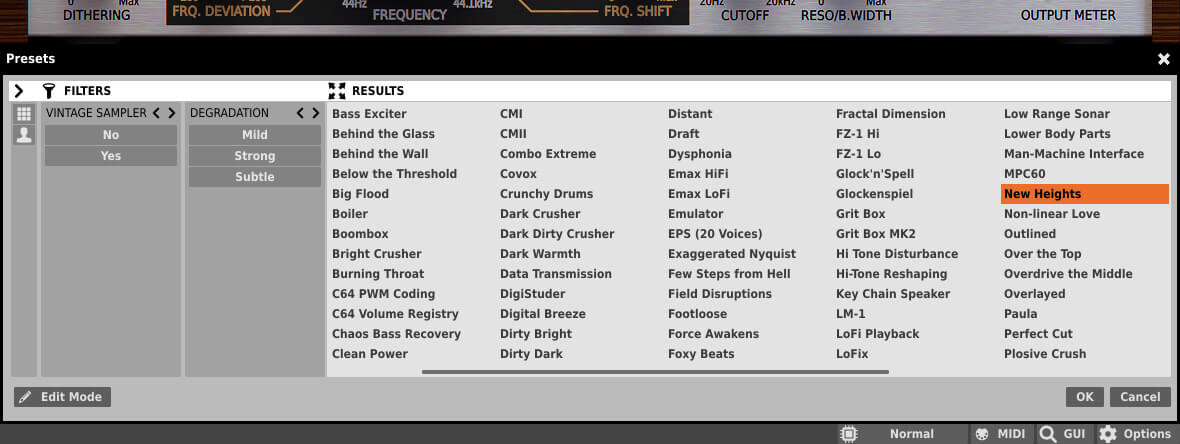
user-friendly browser
Resampling, Aliasing & Filters
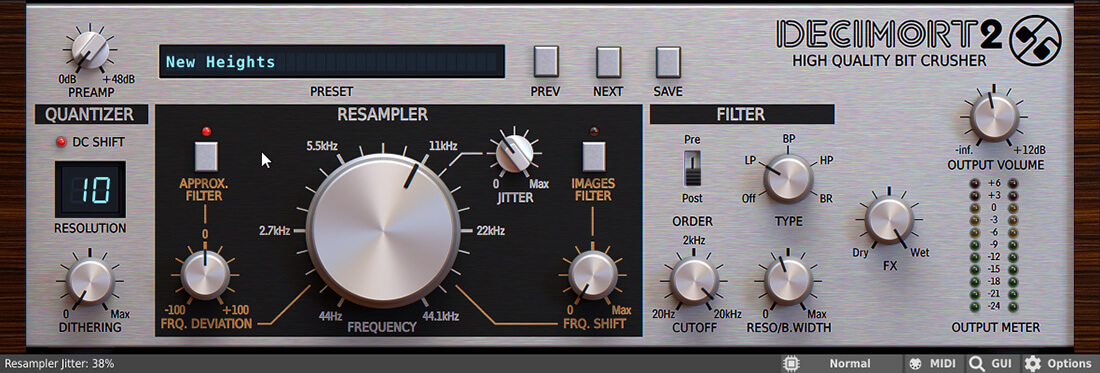
At the core sits the resampler, where you control both resolution and sample rate directly. The resolution parameter reduces the signal from high bit depth down to extremely low values, while the frequency control defines the effective sample rate. Together, these two parameters shape how much detail is lost and how aggressively the signal is transformed.
Before the resampling process, the Approximative Filter removes harmonic content above the target frequency, preventing unwanted aliasing from folding back into the audible range. After the resampling stage, the Image Filter lets you control how much of the remaining aliasing content is preserved. Both filters are linked to the resampling frequency, so they only affect the signal where necessary.
Decimort also includes analog-style filters that can be placed before or after the main processing stage, useful for smoothing out artifacts or pushing certain frequencies further when building more complex chains.
The result is a much more controlled and musical outcome compared to typical bitcrushers. Even when pushed hard, there is no harsh high-end or unpredictable digital behavior. The only artifacts you hear are intentionally modeled after classic hardware.
Jitter: Small Control, Big Impact
A standout feature is the jitter control. It introduces small, random fluctuations in the resampling frequency, creating subtle instability and movement in the signal. I simply love this function!
It’s a simple parameter, but an extremely powerful one, especially when automated. Small adjustments can completely change the feel of a sound. Automation opens up a wide range of possibilities: movement, evolving textures, gradual reshaping for build-ups, breakdowns, and transitions. This makes Decimort a powerful tool for both sample generation and sound design.
The Preamp
The built-in preamp deserves a special mention. It sounds excellent and plays an important role in shaping the overall character, especially when driving the signal into the processing stage. It adds weight and helps sounds sit better in a mix.
It works so well in this context that we carried a similar concept over into the bass drum synthesizer PunchBox. Not as a feature checkbox, but because it genuinely improves the result. The same is true for the core Decimort processing itself. The way it shapes transients and adds density made it a natural fit for a drum synthesizer, where punch and character are everything.
Sound Quality
This is where Decimort 2 really earns its reputation. The signal is reduced in resolution, but the result stays controlled, detailed, and musical. Even stronger settings don’t fall apart. Instead, the sound often becomes more focused and sits better in a mix. That’s exactly what made classic samplers so effective, and it’s what Decimort consistently delivers.
Real-World Use
In practice, Decimort 2 works especially well on drums, loops, basslines, and percussive material. It can also be effective on synths or even vocals when you want to introduce more texture. At the same time, this is not a tool you reach for on every track. It’s something you bring in when a sound needs a specific edge or a more stylized character.
This is clearly a character tool, not a transparent processor. And within that role, it’s one of the most reliable options available.
Verdict & Summary
Decimort 2 is a detailed recreation of a classic digital sound with a level of control that goes well beyond what you’d expect from this category. It delivers authentic vintage sampler character, avoids unwanted artifacts, and stays musical across a wide range of settings.
The jitter control and automation possibilities make it especially powerful for sound design and sample creation. Even after years of use, it holds up.
Decimort 2 earns the Sounds of Revolution Award. If you want a simple bitcrusher, there are plenty of options. If you want real character, this is one of the best choices out there.

Visit my BLOG for other vst recommendations, production tips and more!
Cheers,
Oliver Schmitt aka Sounds of Revolution (SOR)