Review Dawesome Abyss 2
Dawesome ABYSS 2 Review – Turning Sound Into Colour
A Beautifully Different Synthesizer That Makes Sound Design Feel Like Art
First of all, I have to admit that I never really explored the original ABYSS; therefore, I cannot draw a direct comparison with its predecessor. My journey thus begins directly with ABYSS 2.
However, Dawesome is certainly no stranger to me. I really enjoyed LOVE 2, and NOVUM remains one of my absolute favorite granular synthesizer plugins. Developer Peter Vörlander has a remarkable talent for approaching sound design from unusual angles, creating instruments that feel genuinely different from conventional synthesizers.
And ABYSS 2 continues exactly this particular philosophy. Instead of presenting another synthesizer filled with typical oscillators, complex routings and endless modulation matrices, Dawesome asks a simple question: What if we approached sound the same way we approach colour?
The result feels less like programming a synthesizer and more like painting with sound. And the best part? It sounds really amazing.
Sound Is Colour – A Different Approach to Synthesis
We naturally describe sounds as warm, cold, bright, dark, silky, metallic or rough. Interestingly, these are the same expressions we use to describe colours and textures.
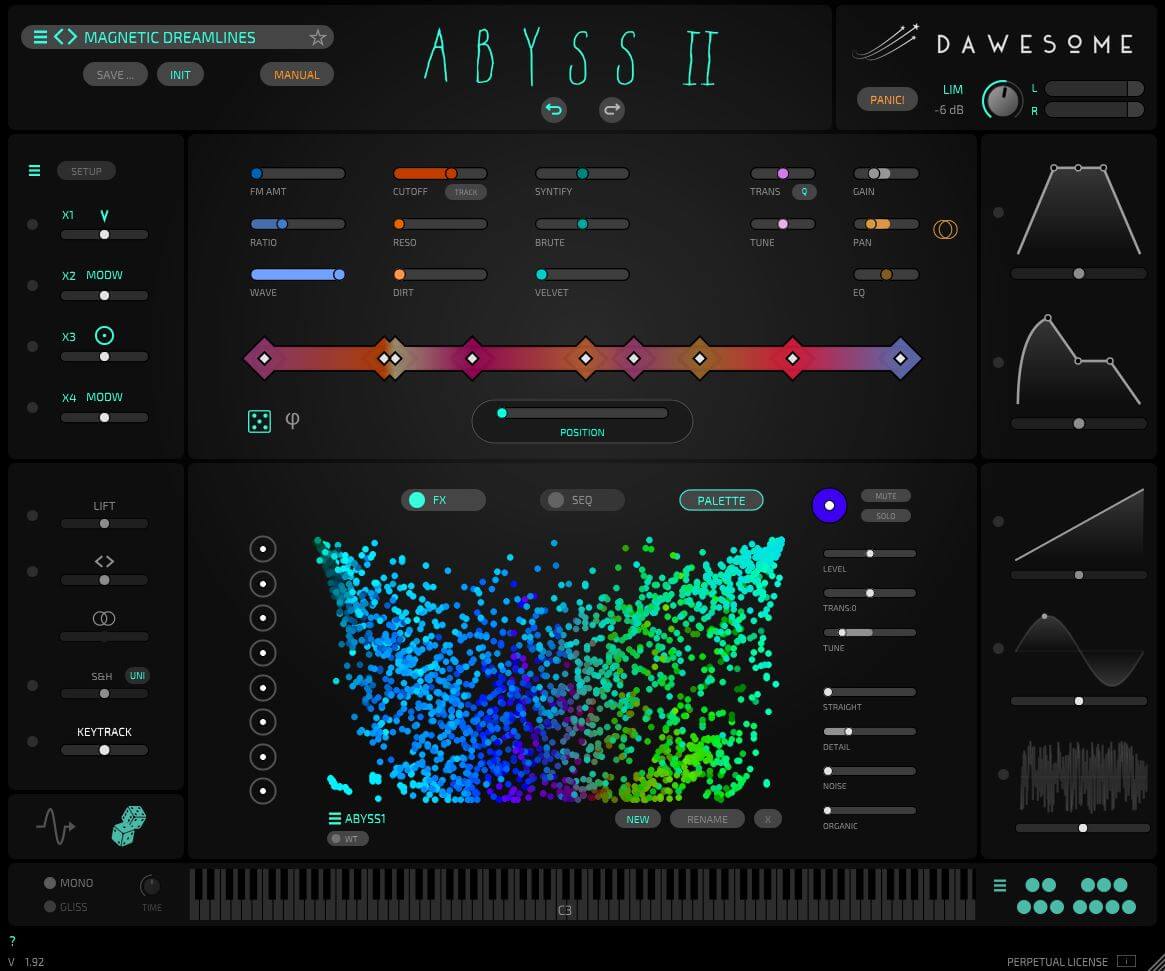
Dawesome builds an entire synthesis concept around this connection. At the heart of ABYSS 2 is the Tone Colour Gradient, where different tonal characteristics can be placed, combined and transformed. Instead of selecting traditional waveforms, you browse through collections of tone colours, listen to what catches your attention and drag your favorites onto the gradient.
Moving along it gradually transforms the sound from one tonal character into another. It sounds almost too simple, but the results can also be really complex.
As a sound designer, I find this approach new and refreshing. Sometimes you want precise control over every parameter, but there are also moments when experimentation leads to something far more interesting than anything you originally planned.
ABYSS 2 is exceptionally good at creating those moments. It’s a tool that can create happy accidents easily. And despite its unconventional interface, there is also plenty of synthesis power under the surface: Filters, envelopes, FM and modulation controls are all available if you want to dive deeper into sound design.
The Magic of the Tone Colour Gradient
The gradient is much more than a simple crossfade between sounds.
Each tone colour represents a particular spectral character, and combining several of them allows you to create continuously evolving timbres.
You might begin with a warm, organic texture, introduce something metallic in the middle and finish with a dark, unsettling atmosphere.
By modulating the gradient position with an envelope, LFO, modwheel or aftertouch, the sound can travel through these characteristics automatically.
A sustained note can develop into an evolving soundscape with constantly shifting harmonics and textures. Add subtle modulation, stereo movement and reverb, and suddenly you have something that feels remarkably alive.
I particularly enjoy how naturally these transitions can develop. Instead of sounding like several unrelated elements layered together, the different tonal characteristics become part of one coherent instrument. At this point, it’s really hard to discribe.
With full MPE support, these transformations can become even more expressive. Pressure and other performance gestures can directly influence the tonal evolution, making ABYSS 2 a great playable instrument.





Sample Import – Where Things Get Really Interesting
For me, one of the most exciting features in ABYSS 2 is the ability to import your own samples and transform them into tone colours.
Of course this expands the creative possibilities immense.
Simply drag an audio file onto the gradient, and ABYSS 2 analyzes its spectral characteristics, extracting tonal information that can be used by its synthesis engine.
Importantly, this is not conventional sample playback! ABYSS 2 uses spectral resynthesis to turn source material into new tonal building blocks. You can also drag samples into the palette area to generate custom collections of tone colours. Even complete folders of audio material can be analyzed and transformed into personal palettes. This is really well thought!
Think about what this means for sound designers. Over the years, many of us have collected thousands of samples: synthesizer recordings, field recordings, processed instruments, vocals, percussion and in my case thousand of experimental sounds. With ABYSS 2, these libraries suddenly become a virtually endless source of new synthesis material.
A short metallic impact might become an evolving atmospheric pad. Or a vocal recording could serve as the basis for an unusual synthetic texture. Even a basic bass loop might reveal tonal characteristics that would be difficult to create using conventional synthesis methods.
And because the extracted tone colours can be combined freely, you are not limited to the character of a single recording.
I also love the possibility of taking a sound created inside ABYSS 2, rendering it and importing it again to generate another palette. This opens the door to an almost endless cycle of resynthesis and transformation.
For those of you who enjoy experimental sound design, this feature alone makes ABYSS 2 extremely interesting.
Sound Shaping – From Silky Smooth to Aggressive
ABYSS 2 includes several tools for shaping the resulting sound, including 3 particularly interesting character controls: BRUTE, VELVET and SYNTHIFY.
BRUTE introduces aggression, saturation and distortion, ranging from subtle harmonic weight to much rougher textures.
VELVET moves in the opposite direction, smoothing and diffusing the sound to create softer, silkier results.
SYNTHIFY adds a more pronounced synthetic character, introducing additional harmonic content and transforming organic material into something more electronic.
What I really like – what I like especially well – is how quickly these controls can alter the character of a sound. Sometimes a single movement is all it takes to transport you to another world. Combining SYNTHIFY with VELVET can be especially interesting, adding harmonic richness while maintaining a beautifully smooth character.
Alongside the more traditional synth parameters, these controls offer an excellent balance between immediate results and detailed sound shaping.
Effects – An Essential Part of the Sound
The effects section contributes significantly to the overall sonic character of ABYSS 2. There are four freely configurable effect slots and 20 available modules, covering everything from conventional processing to experimental treatments. Much of this will be familiar from other Dawesome tools.
Effects such as Cloud, Shimmer and Grains are particularly suitable for evolving atmospheric textures. The Plate reverb is another welcome addition, while the Tape effect can introduce subtle wow, flutter, warmth and a slightly worn character.
Modules can be rearranged freely, and individual effect presets provide useful starting points. I appreciate this straightforward approach because effects are often an essential part of sound design rather than something added at the very end. A relatively simple timbre can create a powerful cinematic atmosphere once modulation, spatial processing, and reverb are added.
The Polyrhythmic Sequencer – More Than Just Pads
One might initially assume that ABYSS 2 is designed primarily for pads, drones, and atmospheric textures (It’s predecessor certainly leaned more in that direction).
And while it certainly excels in those areas, the integrated polyrhythmic sequencer demonstrates that the instrument is capable of much much more. Separate lanes control note activity, velocity, gate length, pitch and octave. The interesting part is that these lanes can operate with different sequence lengths. For example, a 16-step rhythmic pattern can run alongside a nine-step pitch sequence and a 12-step velocity pattern.
Because these patterns repeat at different intervals, their combinations continually change, creating evolving rhythmic structures that take much longer to repeat completely. Combined with the sound engine, the sequencer can produce everything from delicate rhythmic textures to aggressive synthetic patterns. This adds another creative dimension to ABYSS 2, particularly for electronic music and generative compositions. It sounds fascinating – what is possible here.
Presets & Sound Quality – So Beautiful
Let’s talk about something that ultimately matters more than any feature list: How does ABYSS 2 actually sound? Simply fantastic!
The instrument comes with more than 400 factory presets, including newly created sounds and updated material from the original ABYSS. There is plenty to explore, and the overall sound quality is really impressive. Some of the atmospheric presets are absolutely stunning. I could hardly believe what I was hearing.
Deep, evolving pads, mysterious drones, shimmering textures, organic soundscapes and beautifully strange synthetic instruments demonstrate what this synthesis approach can achieve. Many sounds have a remarkable sense of depth and movement. They breathe, evolve and reveal new details as you hold a note or interact with the modulation controls. There are also expressive melodic sounds, unusual plucks, gritty basses, experimental percussion and complex rhythmic sequences.
ABYSS 2 rarely sounds ordinary.
For cinematic music, ambient, experimental electronic productions and creative sound design, this instrument is an absolute wonderful playground. I could easily spend hours browsing the presets, modifying parameters and discovering entirely new sounds along the way.
In general I’m a fan of dark atmospheric sounds – many of my samples have a rather dark character, so I feel right at home with Abyss 2!
Workflow – Creativity Before Complexity
ABYSS 2 certainly encourages a rather intuitive approach to sound. You listen, select, combine, transform, and finally experiment a lot – these are all things that are simply fun. However, its unusual approach may require some adjustment if you are accustomed to conventional subtractive synthesis.
There is also a trade-off. When you have a very specific harmonic structure in mind, traditional oscillators and detailed synthesis controls can sometimes provide a more direct route to the desired result.
ABYSS 2 is less about constructing every element according to a predetermined technical plan and more about discovering interesting sonic relationships.
Personally, I see this as one of its greatest strengths. After all, sound design shouldn’t always feel like pure engineering. Sometimes the most exciting results emerge when you simply stop thinking about technical parameters and just follow your ears.
Room for Improvement
As much as I enjoy ABYSS 2, there are a few areas where I see room for improvement.
First, I think the graphical interface could benefit from a more modern, polished and detailed design. Take Minimal Audio’s LUCID, for example: both plugins utilize dark interfaces, yet LUCID simply strikes me as more sophisticated, professional, and visually appealing. ABYSS 2 feels a little dated in comparison, and some of the labels, particularly in the upper section, could definitely be easier to read.
Another small but welcome improvement would be keyboard navigation in the preset browser. Being able to quickly browse through presets using the arrow keys, without constantly reaching for the mouse, would make exploring sounds easier.
These are certainly no dealbreakers, but a few refinements like these could make an already inspiring instrument even more enjoyable to use.
Verdict & Summary
Dawesome has once again created an instrument that stands out from the crowd. ABYSS 2 combines a unique synthesis concept with outstanding sound quality and a remarkably inspiring workflow. Its rich, evolving textures, expressive modulation and versatile sound-shaping tools make it particularly appealing for cinematic music, ambient and dark experimental electronic productions. I’ll certainly be finding plenty of use for it myself!
For me, the real highlight is the ability to transform my own samples into entirely new tone colours. As a sound designer, I find this incredibly inspiring. It opens up creative possibilities that go far beyond conventional sample playback.
What I particularly appreciate about Dawesome is the willingness to explore new approaches to synthesis rather than simply following established concepts. ABYSS 2 is another excellent example of that philosophy.
And most importantly, it sounds beautiful! It’s a wonderfully creative instrument with a distinctive sonic character that makes exploring new sounds a real pleasure.
Dawesome ABYSS 2 earns the Sounds of Revolution Award.

Visit my BLOG for other vst recommendations, production tips and more!
Cheers,
Oliver Schmitt aka Sounds of Revolution (SOR)