Review iamReverb Audio – iamReverb
iamReverb Review: One of the Most Natural-Sounding Reverbs I’ve Heard
Launching a reverb plugin as your first product is a bold move. It’s a crowded and fiercely competitive market, with established developers offering excellent options. That made me curious about Vienna-based iamReverb Audio and its debut release, iamReverb. And for a first product, it’s an impressively accomplished start.
Natural room reverbs usually aren’t my first pick for sound design. I tend to reach for effects with more character, especially with samples from analogue and modular sources. But iamReverb’s take on spatial depth got my attention.
What impressed me right away was how naturally the reverb sits with the source. It can feel as though the sound simply belongs in the room. That made me want to dig deeper.
First and foremost, iamReverb sounds like a room rather than an effect. It doesn’t sit on top of the source – it immerses it in the space. Everything about how it’s built seems to serve that one idea.
Close, Mid and Far: Thinking in Perspectives
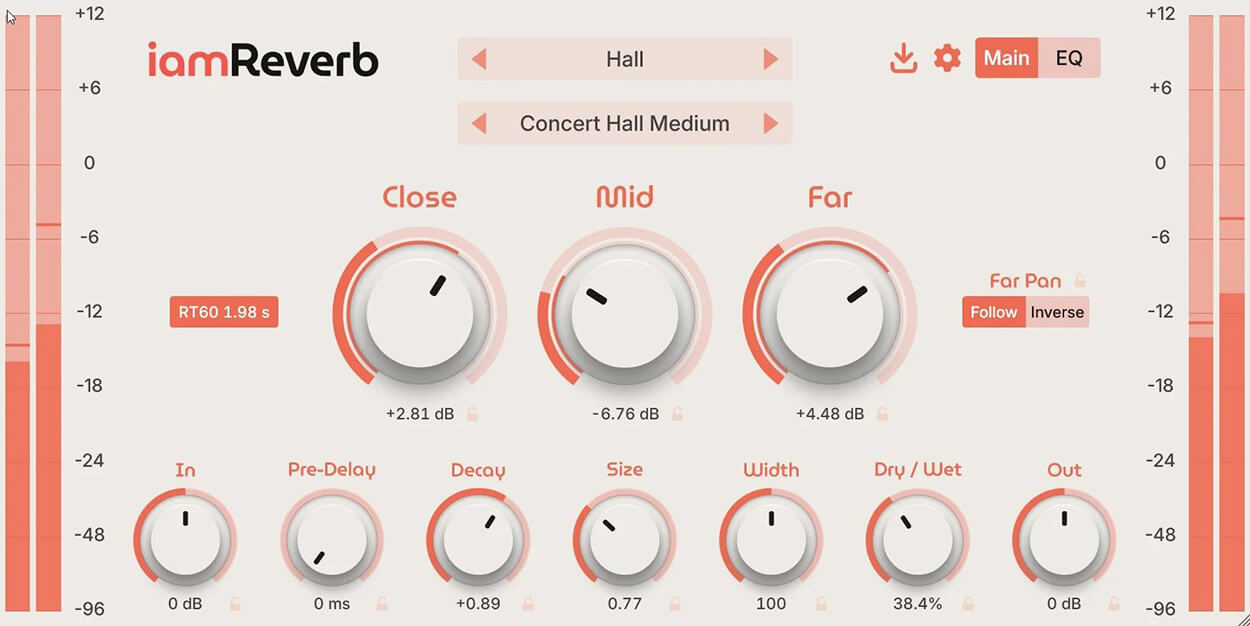
The three distance controls are the heart of iamReverb’s workflow. I think it is helpful to visualize them as three pairs of microphones positioned at varying distances from the sound source. They combine complementary impulse-response captures: the closer position contributes a more immediate perspective, while the more distant ones emphasise the surrounding space.
Blending these signals offers greater flexibility than selecting a single listening position;. And this is precisely what allows the sound source to feel embedded in the space, rather than sounding like a mere effect signal.
Close, Mid and Far do not simply mean „short“, „medium“ and „long“ reverb, nor are they separate controls for early, middle and late reflections. They shape spatial perspective, while Decay controls the duration of the reverb tail.
For sound design, that distinction really matters. A small room can still suggest distance, and a long tail does not automatically make a sound source appear far away.
I really like the approach taken here.
ERM: Attention to the Early Reflections
iamReverb is based on convolution, applying captured impulse responses to an incoming signal. The developer calls its approach Enhanced Reverb Modeling, or ERM.
According to iamReverb Audio, its recording technique captures early reflections at close distances while avoiding unwanted interference from the direct signal. The intended benefits include clearer spatial information and a more defined low-frequency response.
What I like is that the beginning of the room response gets so much attention. Early reflections provide important cues about proximity and the surrounding environment. For me, what counts in practice is how convincingly source and room work together.






Why This Matters for My Sample Packs
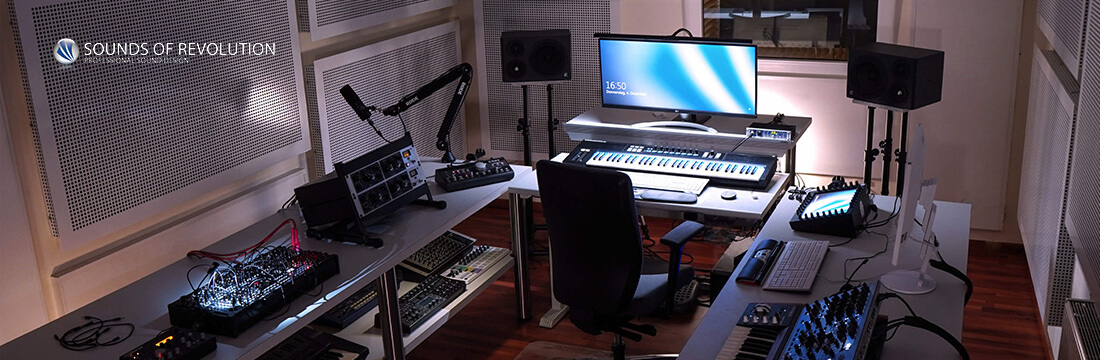
When I make sample packs, I always have to strike a balance. A sample should sound inspiring and ready to use, but too much reverb can limit what someone can do with it in a production. Where it makes sense, I therefore include both dry and wet versions of a loop, giving users the choice.
What really impressed me about iamReverb is that I can give a sample a sense of space without making it sound obviously reverberant. The room is there, but it doesn’t call attention to itself. It gives the sound a place without committing it to a dominant reverb effect.
This is especially useful when I record external sources such as modular systems or analogue synthesizers. These signals can be extremely direct and bone dry. I like using iamReverb to soften that sense of proximity slightly, helping the sound settle more naturally into a mix. For this, it’s worth its weight in gold: the ambience blends into the source instead of sounding like an effect on top.
That lets me add a subtle sense of space while leaving room for the producer’s own decisions, whether they’re experienced or just starting out. For my sample work, a finished sound that stays flexible is invaluable.
Control Without an Overcomplicated Interface
The full version provides Predelay, Decay, Size and Width alongside the distance controls. Predelay adjusts the onset of the wet signal relative to the dry source, Decay shapes its duration, and Size changes the perceived scale of the space.
I particularly like the integrated EQ. Its four tonal bands plus high- and low-pass filters provide six bands for shaping the reverb signal.
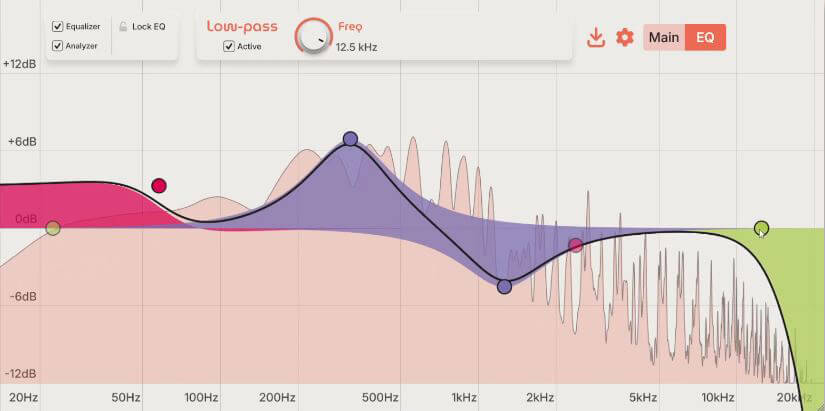
Everything is clearly laid out and easy to edit, so I can adjust the tonal balance quickly without breaking my flow. That clarity runs through the whole plugin. The layout makes sense immediately, and the controls are self-explanatory. I never needed the manual, yet there’s still plenty of room for detailed adjustments.
The continuously scalable GUI is a great detail, too.
Every parameter also has a nice lock function, which is very practical when switching between presets. I wish other developers would integrate something like this.
Far Panorama: Balancing the Stereo Image
Far Panorama offers two settings, Follow and Inverse, that determine the stereo orientation of the Far reverb contribution.
Imagine a single guitar or synth sound panned to the right. In Follow mode, the distant reverb can also lean towards that side, concentrating both the source and its ambience in the same area of the mix.
Inverse swaps the left and right channels of the Far contribution. This allows the distant ambience to lean towards the left while the original sound stays on the right. The Close and Mid contributions are unaffected.
I like using this when I have panned an individual drum hit quite far to one side within a loop. With Inverse, I can bring more of its distant ambience into the opposite side, creating an interesting interplay between the hit and its room sound. It gives me another way to shape the stereo arrangement without moving the drum hit itself. Simply a super great feature!
To me, this shows the developers thought carefully about how to extend the plugin in a meaningful way. It’s a simple control, but it opens up a genuinely creative approach to mixing.
What I Miss: Additional Colours and Creative Controls
I’d love to see spring and plate reverbs added to the library. The focus on natural acoustic spaces makes sense, but these additional flavours would expand its creative possibilities. Spring reverbs (e.g., u-he Twangström) matter a lot in my workflow. I often use them with samples from analogue and modular sound sources. Their resonant, sometimes metallic character can become part of the sound itself, adding texture and space.
I also miss a built-in ducking control, like the one in FabFilter Pro-R 2. I often use reverbs as insert effects in sound design, and ducking helps keep the source clear by reducing the reverb while it plays, then allowing the tail to emerge afterwards. Having it built in would simply speed things up.
A tempo-sync option for Predelay would also be welcome. When working with rhythmic loops, selecting a note value such as 1/16 directly would be more convenient than calculating the time in milliseconds.
Although this leans more towards sound design, a built-in gate would also be a useful addition for my sample work. Being able to cut off the reverb tail deliberately would open up more rhythmic possibilities, especially for drum loops and percussive synth sounds. I can achieve this with external processing, but having that control inside the plugin would be more convenient.
A “favourite presets” function would also make sense. Being able to call up my personally most interesting presets directly, without going through the “user presets”, would speed up my workflow.
But these are all fairly minor points. The sound itself is absolutely convincing!
Price and the More Affordable Lite Version
Let’s move on to the price. A few people have already sounded off about it in forums and YouTube comments, and I can see why: at a listed $299, the full version is a significant investment, especially if you already have several great reverbs in your studio.
There is a more affordable alternative: iamReverb Lite, listed at $99. It retains ERM and the Close, Mid and Far controls, along with Predelay, Decay and Far Pan. Lite offers a smaller library, omits Size and Width, and replaces the full EQ with high- and low-pass filters.
For me, Lite is worth considering when natural room character and straightforward depth control are the main priorities. The full version becomes more attractive when its additional shaping controls justify the extra cost.
And yet, I have to say: the quality of the reverb is truly outstanding, and for me it justifies the investment. I don’t know of any other natural-sounding reverb that can be tailored so precisely to the signal with so few parameters.
Both versions use iLok licensing, with machine activation available alongside iLok Cloud and supported USB dongles. I highly recommend trying out the 14-day trial, and I am sure the results will impress you.
Verdict & Summary
iamReverb is one of the most natural-sounding reverbs I have ever heard. The way it integrates with the source is exceptional, and its intuitive controls make convincing depth surprisingly easy to shape.
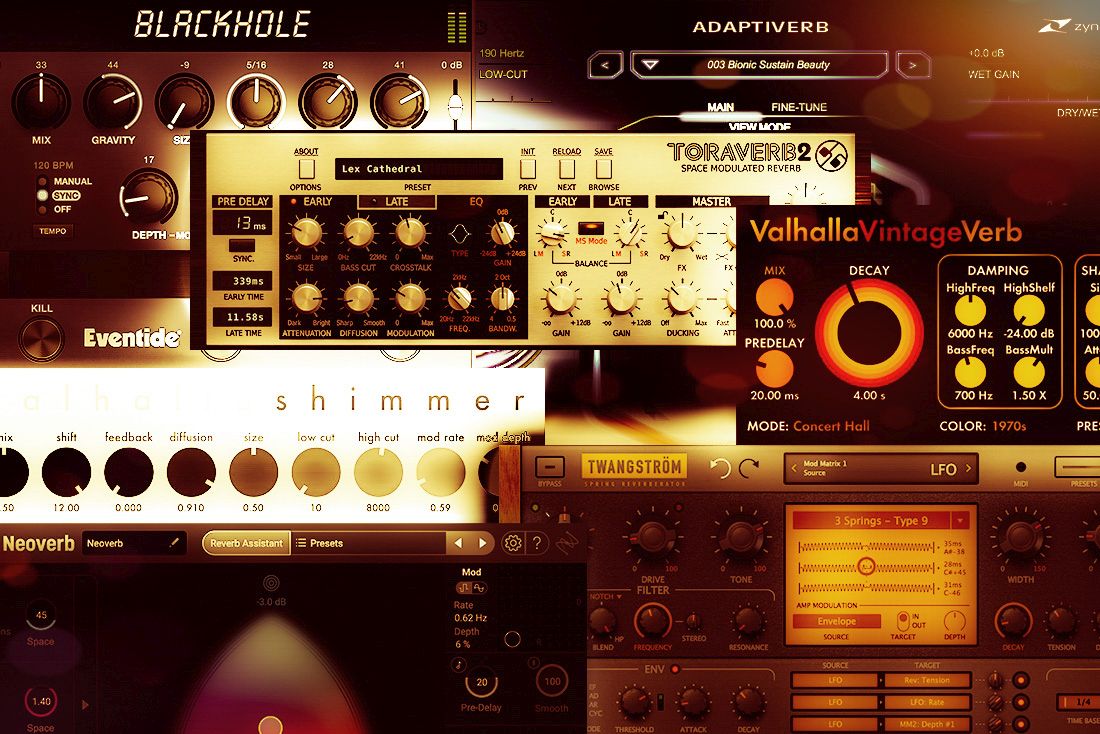
For me, it deserves the Sounds of Revolution Award. Its convolution-based approach, built around captured rooms and three distance perspectives, differs considerably from the algorithmic approach of Valhalla’s reverbs or FabFilter Pro-R 2.
Still, it clearly earns a place in my Best Reverb Plugins selection.
In my own work, it has become the reverb I reach for when a sound should feel placed in a room without being washed out by an effect. That is sometimes exactly what I need for some samples and for taking the edge off very direct, dry sources.
The thing most likely to put people off is the price of the full version. It’s a lot of money, even at this level of quality. Thankfully, Lite offers a more affordable way to experience the core concept.
I have to say, I’m genuinely blown away that this is a debut. Well done, iamReverb Audio!

Visit my BLOG for other vst recommendations, production tips and more!
Cheers,
Oliver Schmitt aka Sounds of Revolution (SOR)