Review Sonible Smart Comp3
Sonible, an Austrian developer, has been at the forefront of AI-assisted mixing for years. What I value most is their willingness to move past analog emulation. Rather than looking backwards, their plugins are designed around what’s possible in the digital domain today. Smart Comp3 is a clear example of that mindset.
Core Concept: Perceptual Compression Instead of Numbers
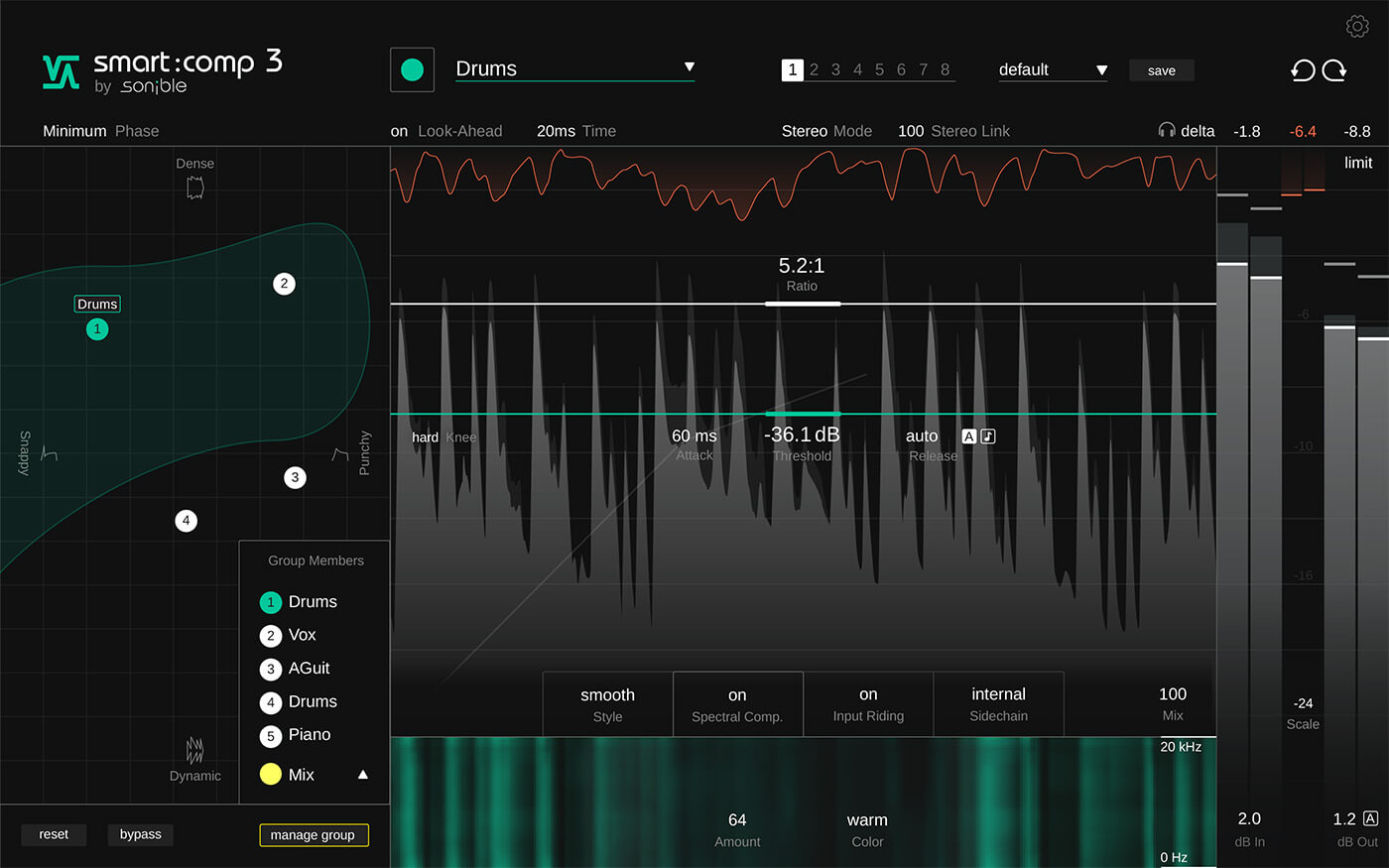
Smart Comp3 by Sonible takes a fundamentally different approach to compression. Instead of starting with attack, release, ratio, and threshold, the focus is on perceptual results. The Compression Matrix lets you shape dynamics in terms of punch, density, snappiness, and overall movement, based on what the signal can realistically deliver.
The matrix is signal-dependent and visually limits the usable range. This is not about restriction, but about guidance. It shows where compression makes sense and where it stops being musical. This is a completely different approach than what you’re used to. Super intuitive and simply fun to work with!
Compression Matrix Shaping Results Not Parameters
The matrix is not a linear XY controller. Moving within it can trigger complex, non-linear changes across multiple parameters under the hood. Even when the values look extreme, the audible gain reduction stays stable and predictable. You’re effectively working within a safe zone, and the results remain consistently usable.
Operating a compressor hardly gets any simpler. This also makes Smart Comp 3 very approachable for beginners.
At the same time, the workflow shifts away from technical micromanagement toward intentional sound shaping. You decide how something should feel, not which parameter to tweak next.
Input Riding: A Real World Game Changer
Input Riding is one of the most important additions in Smart Comp3. It performs transparent, macro-level gain riding before compression, comparable to manually riding a fader.
Large level differences within a single track, such as quiet verses and loud choruses, can now be handled by one instance without track splitting or complex serial chains. Used subtly, input riding alone can already be useful in mastering, especially for dynamic material like acoustic recordings, orchestral music, soundtracks, or, in my case, field recordings.
Crucially, this process does not reshape the envelope or add coloration. It simply stabilizes the level in a very natural way. Comparable paid tools include NoiseWorks GainAim or Waves Vocal Rider. Integrating a similar function directly into Smart Comp3 is simply brilliant.










Spectral Compression Musical Balance Across Frequencies
The spectral compressor redistributes compression energy across the frequency spectrum instead of treating the signal as a single full-band event. This results in a more balanced and musical response, especially on vocals, acoustic instruments, and dense material.
Natural, Bright, and Warm modes allow tonal steering, while bandwidth control makes it possible to focus processing on specific frequency ranges. In practice, this often replaces complex dynamic EQ setups with a faster and more coherent solution.
Group Mode True Multi Track Control
Group Mode turns Smart Comp3 into a powerful multi-track dynamics system. Multiple instances can be grouped and controlled from a single interface, while each track is still analyzed and processed individually.
Batch adjustments for ratio, attack, release, and mix allow fast balancing across drums, guitars, bass, or strings without flattening their individual character. The visual overview of all grouped instances helps maintain perspective instead of working track by track in isolation.
Styles and Workflow Flexibility
– The Style section now covers a wider character range without adding complexity.
– Clean remains a neutral and reliable default.
– Smooth softens envelope behavior.
– Aggressive adds density and edge through altered timing and saturation.
– Custom allows full manual shaping when deeper control is needed.
Zero latency mode, improved input weighting, and automatic output compensation make smart:comp 3 suitable for both tracking and mixing scenarios.
Transparency and Reliability
Even under heavy gain reduction, smart:comp 3 remains controlled and natural. Pumping, harsh envelope distortion, or unnatural artifacts are notably absent. This consistency across vocals, acoustic instruments, drums, and complex arrangements reinforces trust in the tool.
Verdict & Summary
Smart Comp3 does not automate creative decisions, but it removes unnecessary friction. By combining perceptual control, transparent input riding, spectral processing, and intelligent group workflows, it reduces the need for multi stage dynamic chains while staying musically dependable.
What stands out in daily use is how consistently predictable the results are, even across very different sources and dynamic ranges. It encourages faster decisions without sacrificing control or depth.
The concept behind Smart Comp3 is genuinely unique. It redefines how compression can be approached without dumbing it down or hiding professional control. In my case, it’s mainly about shaping and compressing loops. And here, using the matrix is not only fun, but you also quickly achieve great results that you certainly wouldn’t have achieved so intuitively and quickly with conventional compressors.
For this reason, smart:comp 3 receives the Sounds of Revolution Award. Not because it replaces skill, but because it translates intent into results in a way no traditional compressor does.
I usually run this alongside smart:limit. It delivers convincing results with minimal effort.

Visit my BLOG for other vst recommendations, production tips and more!
Cheers,
Oliver Schmitt aka Sounds of Revolution (SOR)