Review Polyverse Filterverse
I’ve been a Polyverse fan for a long time. They’ve been around since 2015, and their tools have always had a clear identity: creative ideas that actually translate into usable results in real productions. Manipulator is probably their most well-known product, and I also like tools such as Gatekeeper when I need quick movement in static loops.
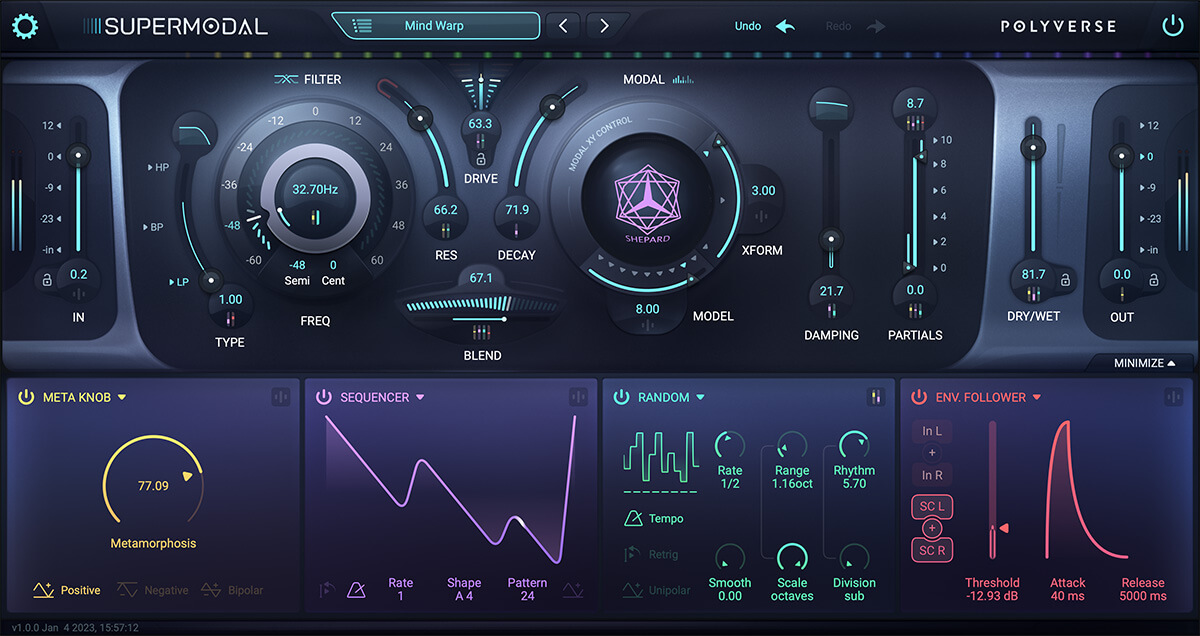
With Filterverse, Polyverse went a step further. For me, this is the strongest product in their lineup. It builds on the direction Supermodal introduced earlier, and the beautifully designed interface clearly reflects that heritage. Filterverse does not feel like a standard effect plugin. It feels like a creative sound design tool you can integrate into real-world workflows, not just use for experimental one-off sounds.
What Filterverse actually is
Filterverse does not stand out just because of the sheer amount of filters available. What makes it special is how filtering becomes a creative process instead of a technical task. It invites experimentation, but at the same time gives you enough control to stay intentional with what you are doing. I rarely feel both this free and this in charge when working with a filter plugin.
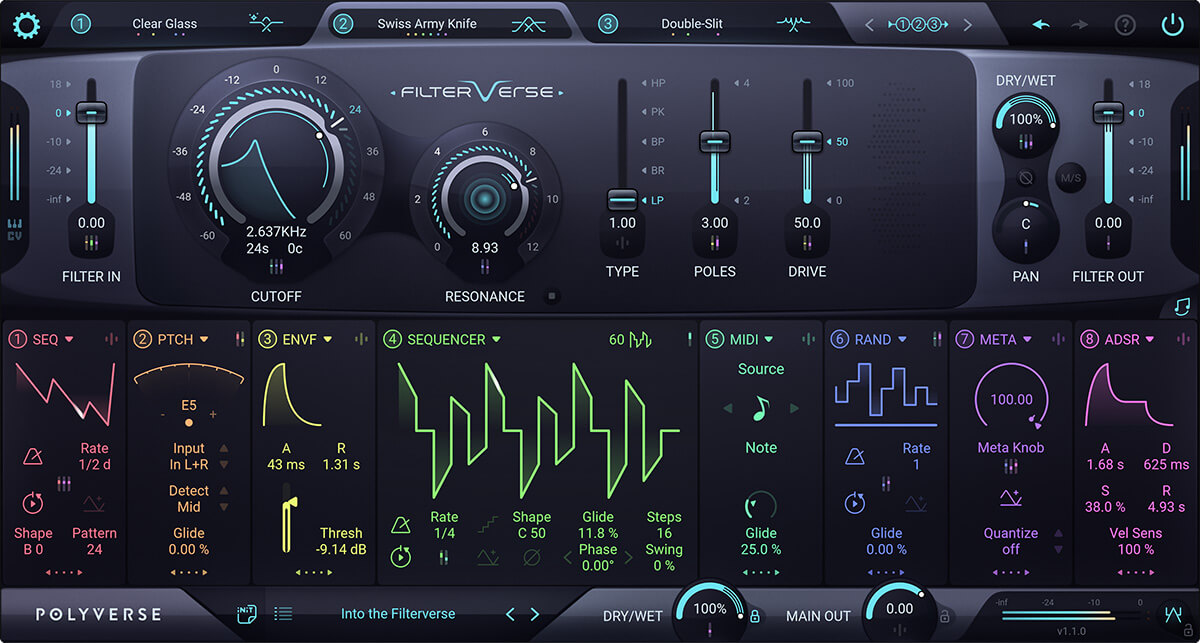
Built around a multi-filter concept with serious depth:
30 different filter types, from classic to experimental
250+ algorithms
Three filter slots with flexible routing
Serial, parallel and hybrid routing modes
Eight modulation sources available at once
Stereo modulation, panning and Mid/Side processing
Cross-modulation between modulators
Optimized for audio-rate modulation
More than 1000 presets
An interface designed for fast results without constant menu-diving
This is not a utility filter, but a creative sound design environment. The GUI is particularly well done. It looks fresh and modern, and even though it can feel a bit overwhelming at first, the layout is logical and intuitive. Once you understand the structure, navigation is fast and you rarely have to dig through menus. The color coding helps a lot when working with complex routings and modulation setups, which makes the whole system much easier to read in practice.
Sound character: controlled when you want it, extreme when you need it
Filterverse covers a wide range of sounds. It works perfectly fine as a clean, musical filter for subtle tone shaping. That alone would already make it useful. But the real strength comes from the more characterful and experimental filter types.
You can push sounds into metallic, resonant territory, create vocal-like movement, build complex multi-peak textures, or turn simple material into rhythmic, animated layers. Delay-based and spatial modules extend this further, so Filterverse often replaces entire effect chains in practice.
What I like is that it stays usable even when pushed hard. It can get aggressive, but it does not fall apart sonically. You can decide how far you want to go, from tasteful enhancement to full-on sound transformation.
Routing and multi-slot workflow
Using multiple instances of Filterverse in series is also very effective. One instance can handle tone and character, another movement and modulation, and another space or more destructive processing. This opens up a lot of creative freedom and makes Filterverse feel more like a modular system than a single effect.




Modulation: where things really start to move
Filterverse allows up to eight modulation sources at the same time. Mapping modulation is fast and visual, and you can stack multiple modulators on one parameter or let modulators influence each other.
This is where Filterverse becomes very powerful for sound design and modern electronic production. You can create subtle movement that keeps sounds alive, or push into more extreme, almost synth-like modulation behavior. Stereo modulation and Mid/Side options add another useful dimension, especially for pads, textures and FX.
A simple example: using the envelope follower on a comb filter on a snare instantly added a metallic shimmer that followed the transient in a very musical way. These small setups already show how quickly Filterverse can turn basic material into something more expressive.
The system is deep, but it is laid out in a way that encourages experimentation instead of slowing you down.
Presets and idea generation
Filterverse comes with more than 1000 presets. It’s honestly impressive. Stepping through them is already a creative process on its own. It is easy to stumble upon sounds and movement patterns that spark ideas you would not have come up with manually. I rarely have as much fun browsing presets as I do here. It quickly becomes clear how wide the range of this tool really is.
In practice, I often use presets as starting points. I browse, stop when something catches my attention, then break it down and rebuild it into something that fits my loop. This makes Filterverse very fast to work with, even though the plugin itself offers a lot of depth.
Practical notes and downsides
Filterverse can be CPU-intensive, especially with complex routing and modulation at higher quality settings. In larger projects, using many instances can become heavy. A realistic workflow is to use it for sound design and then resample the results.
One small thing I would like to see in future updates is built-in tooltips. The manual is very detailed and genuinely helpful, but having short explanations directly inside the plugin would make exploration even smoother, especially when working with more experimental filter types and modulation options.
The learning curve is there – that’s just how it is. You can get good results quickly, but the deeper potential takes some time to fully understand. The upside is that the plugin rewards that time investment.
Verdict & Summary
Filterverse stands out because it balances depth and usability in a way that very few creative effects manage to do. It can be simple when you want it to be, but it scales into real complexity when you need it. The sound quality is consistently high, the modulation system is genuinely powerful, and the routing options make it easy to explore new sonic directions without rebuilding entire effect chains from scratch.
This is not a plugin you buy just to have another filter in your collection. It’s a tool you integrate into your workflow. Whether you are shaping drums, animating pads, transforming vocals, or building completely new textures from simple sources, Filterverse gives you precise control over how far you want to push things.
Filterverse invites exploration without a fixed goal and still leads to usable results. It has become a go-to plugin for me when I want to twist material into something new or simply see where a sound can go. For me, it is currently the best creative filter plugin available.
Yes, it demands CPU resources and rewards users who spend time learning it. But that’s a fair trade-off for the level of creative freedom it offers. Without any doubt, Filterverse has earned the Sounds of Revolution Award.

Visit my BLOG for other vst recommendations, production tips and more!
Cheers,
Oliver Schmitt aka Sounds of Revolution (SOR)