Review DataMind Audio Refractalizer
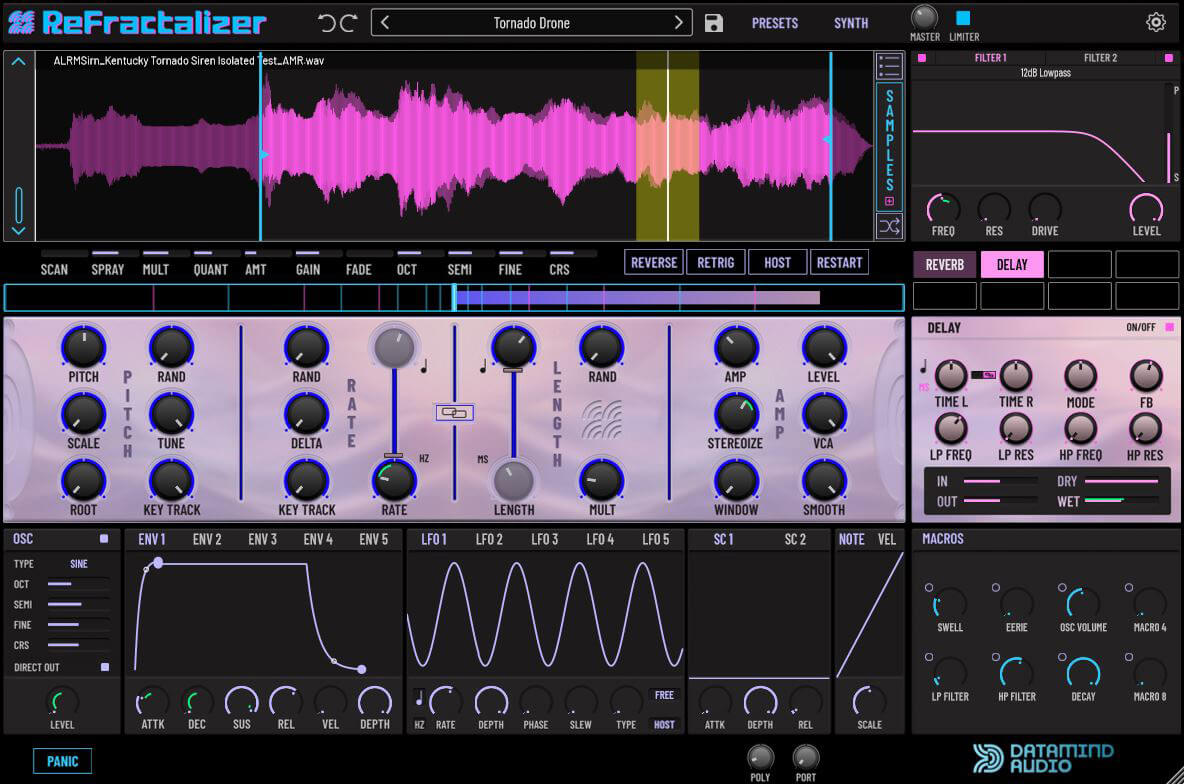
DataMind Audio Refractalizer – My current No. 1 Granular Synth
I didn’t expect this. I’ve tested a lot of granular instruments over the years, and honestly, most of them start to feel similar after a while. Refractalizer didn’t. This plugin genuinely surprised me, and that doesn’t happen often anymore.
For me, Refractalizer is the most exciting granular synth available right now.
What makes it special isn’t just the sound quality; it’s the concept. Refractalizer doesn’t treat granular synthesis as a random texture generator. It turns it into a musical instrument. You can bend time, morph samples, and move seamlessly between rhythmic chopping, pitched tones, evolving pads, and classic synth behavior. One moment you’re slicing a drum loop, the next you’re playing chords made from a vocal fragment.
The core idea is brilliant: grain rate can be driven by MIDI notes. That means the grains themselves become the oscillator. You’re no longer “spraying” grains, you’re playing them. Leads, basses, chords, percussive hits – all with the character of micro-sampled audio. It feels like a real synth, not an effect.
Then there’s the multi-buffer engine. You can load thousands of samples into a pool and smoothly interpolate between them. Not switch. Not crossfade crudely. True interpolation. You can scan through an entire folder of sounds with an LFO, a macro, or automation. I don’t know any other granulator that can do this in such a direct and musical way.






This alone turns Refractalizer into a sound design machine:
– Morph between drum hits to create evolving percussion
– Blend multiple bass layers into a single living tone
– Turn a folder of field recordings into an infinite wavetable
– Animate vocal fragments into harmonic instruments
The time domain is just as innovative. Refractalizer lets you interpolate between BPM-synced divisions and exact Hz values. You can sweep from a 1/16 groove into pitched tones in one gesture. Rhythms melt into melodies. Textures drift in and out of time. This is not a switch; it’s a continuum.
Add to that stereo grain cycling, where successive grains bounce between left and right channels. At slow rates, it adds motion. At a high rate,s it creates phantom harmonics and a psychoacoustic width that you simply can’t get from chorus or EQ.
The result is a synth that feels alive. Even simple source material becomes deep, animated, and expressive. One sample really can turn into infinite variations.
It does take a bit of time to really grasp the depth of Refractalizer, and at first, it can feel almost untamable because the possibilities are so vast. But that learning curve is absolutely worth it. Once it clicks, it opens up genuinely new sound territory, especially through its ability to interpolate between samples. It’s genuinely fun to drop your own samples into the presets and watch what happens, because with a single click, you often end up with something inspiring and already have a beautiful foundation to build on.
Yes, it’s CPU-intensive in extreme settings, especially with long grain lengths. That’s the nature of this kind of processing. But in practical patches, it’s absolutely manageable, and the sonic payoff is worth it.
Since the possibilities are enormous, I recommend the YouTube playlist. It makes getting started much easier.
improvement request
I’m currently missing the option to listen to the unprocessed version of a sample after importing it. Being able to switch between before and after with a single click is very important to me. A “hot swap” function, similar to Ableton, would also be extremely practical for quickly replacing samples. I reached out to DataMind Audio about these points, and they told me that both features are likely to be added in a future update. Once this is implemented, the tool will be close to perfect in my opinion.
Verdict & Summary
Refractalizer is not just “another granular plugin”. It’s a new category: a temporal modulation instrument, a sample-morphing synth, a playground for serious sound designers. It offers features and workflows that simply don’t exist anywhere else, and that uniqueness is exactly what sets it apart.
If your work revolves around texture, motion, hybrid sounds, cinematic design, experimental music, or simply pushing audio into new territories, this plugin is exceptional.
For me, it’s the best granular synth on the market right now – and one that fully deserves the Sounds of Revolution Award.

Visit my BLOG for other vst recommendations, production tips and more!
Cheers,
Oliver Schmitt aka Sounds of Revolution (SOR)